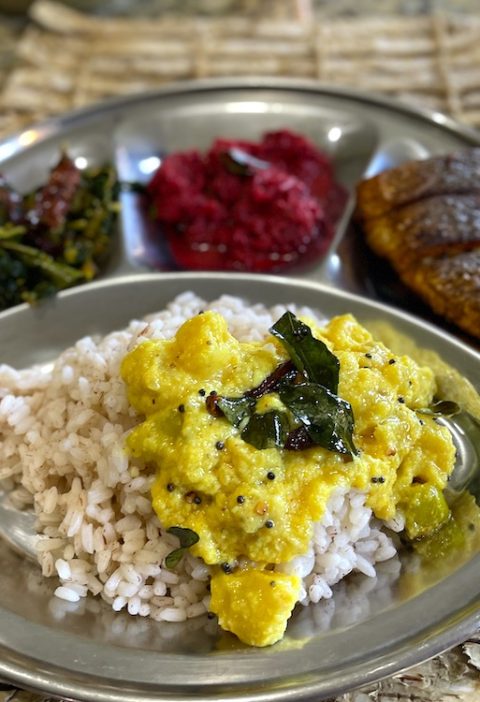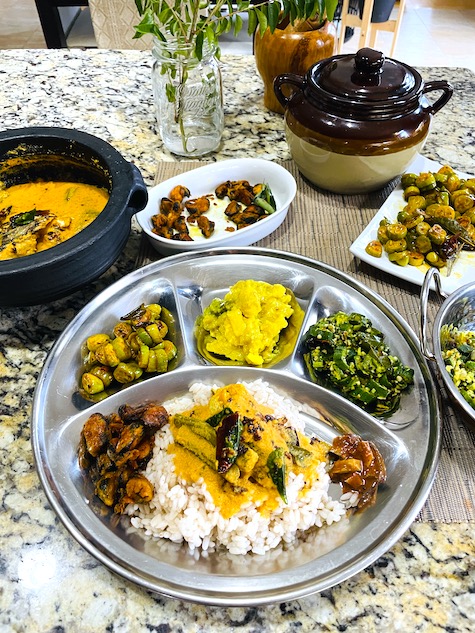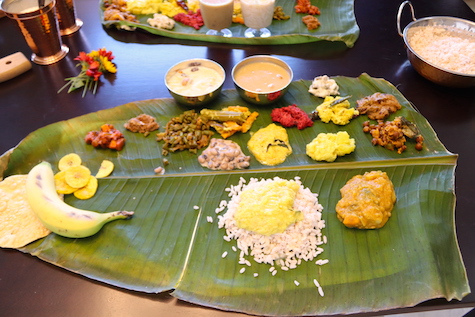
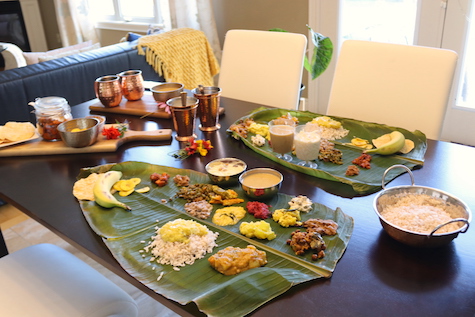
Sadya is not the name of one dish, it’s a grant feast involving many vegetarian dishes served on a banana leaf. It is the popular vegetarian meal of Kerala served during festivals and special occasions.
Having born and brought up in Kerala aka God’s Own Country, I had the opportunity to taste most of the Kerala delicacies. In Kerala, there are 14 districts, and each district has it’s own specialty dishes. Even the style of cooking, recipe, name of the same dish varied greatly from one district to another. Kerala food is rich, flavorful, aromatic, spicy and unique, the more you eat the more you fall for this cuisine. I can go on and on when talking about Kerala food. After I got married, I moved to the US, it was there I was opened to other cuisines and started exploring the incredible world of cooking and food. When I first started cooking, I was only aware of South Indian dishes and a few Indo-Chinese dishes.
Even after exploring other cuisines, for me comfort food means: ‘My own Kerala food’. When thinking about Kerala food, first thing that comes to my mind is Kerala Sadya. ‘Sadya’ means ‘Banquet’ in Malayalam (Official language of Kerala). Sadya is not the name of one dish, it’s a grant feast involving many vegetarian dishes, it could range from 15 to 24 or more. Sadya is often made during special occasions like Onam ( biggest festival in Kerala), marriages, birthdays, and other occasions.
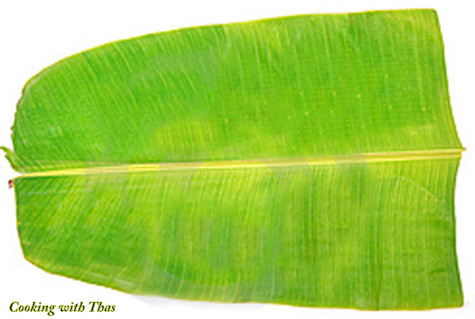
Sadya is served on Plantain or Banana leaf, which could be also called as the Organic plate. While eating Sadya people mostly sit on the floor with crossed legs and it is eaten using the right hand and fingers, the natural spoon, which greatly enhances the taste of the sadya and helps to combine all the dishes.
The dishes found in Sadya are all vegetarian, some of the common dishes found in Sadya are:
Main dishes: Rice, Parippu (lentil curry), Sambar (mixed veggie curry), Rasam (spicy, tangy soup kinda curry)
Side dishes: Avial (thick veggie side dish made with yogurt), kalan (plantain dish made with yogurt and coconut), Olan (black-eyed peas curry in coconut sauce), Pachadi (made with beetroot/lady’s finger in yogurt), Thoran (sauteed mixed veggie with grated coconut), Pulissery (ripe mango, pineapple or pumpkin cooked in coconut-yogurt)
Pickles: Inji puli (ginger/tamarind pickle), Achar (pickles made with mango, lemon, or gooseberry)
Snacks: Upperi (fried Plantain coated with jaggery), Plantain chips, Pappadam (crispy, crunchy Indian wafers, made from lentil, black gram, etc), Banana.
Dessert: Payasam (made with vermicelli, milk, sugar and other added flavors), mostly 3 types of payasam are served for sadya: Semiya payasam (vermicelli cooked in milk and sugar), Palada pradhaman (thick dessert made with cooked rice) , Kadala pradhaman (made with chana dal).
Oh yes, only if you make all these dishes it can be called Sadya. With just 2 or 3 of these dishes it’s just everyday Kerala food served in almost all houses.
Without any doubt, Sadya is one of my favorites, as I get to enjoy almost all kinds of flavour & taste from spicy to sour to sweet in just one eating 🙂
Ingredients found in most of the dishes in Sadya:
Coconut grated, Coconut oil, Yogurt (Curd), Vegetables like: plantain, Mango, Okra or lady’s finger, Beetroot, Ash guard (found in Indian grocery stores), Green chili, Black eyed peas.
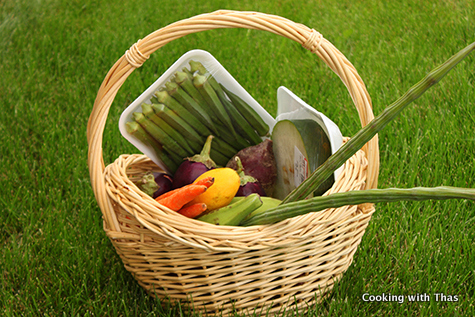
Spices needed for making Sadya:
Turmeric powder, Cumin seeds, Whole Mustard seeds, Whole dry red chili, Curry leaves (found in Indian grocery stores), Freshly grated Ginger, Fenugreek seeds, Salt.
For making tempering or Seasoning:
Coconut oil, Mustard seeds, Whole Dry Red Chili, Curry leaves, Small onions, Fenugreek seeds.
Kerala is the land of Coconut, hence coconut is the primary ingredient in most of the dishes. Also, Coconut oil is used for cooking sadya dishes, as it really enhances the taste, so make sure to cook Sadya dishes using coconut oil.
You could find all these above-mentioned ingredients added in most of the dishes and the most amazing part is each dish has its own personality and it tastes entirely different from others. Hence, Sadya could be defined as the Flavorful Veggie palette which gives a myriad of flavors to your taste buds, your taste buds will go crazy tasting all the sweet, spicy, and tangy dishes.
How to serve Sadya on a Plantain Leaf
While serving the dishes on the plantain leaf which has two sides, each item has its own specific place, for instance: Pickles are served on the top left on one side of the leaf, followed by other side dishes and banana is served on the bottom left corner. While, Rice along with Parippu and Sambar/Rasam, and the Payasam are served on the immediate side facing the person.
I have to say all these before writing about the recipe because Sadya is given great importance in Kerala which is served and devoured with great pride by everyone irrespective of their taste buds.
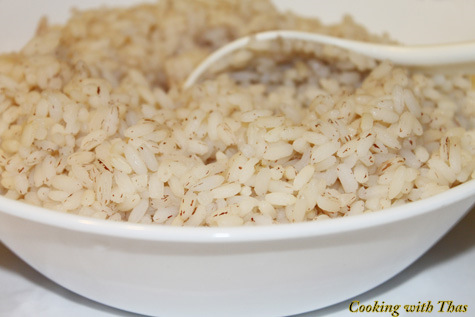
Kerala’s traditional Kuthari Rice or Red Rice
Ingredients:
- Raw Kuthari Matta rice/Rosematta Rice – 2 cups
- Salt- 1/2 tsp
- Water- 5 to 6 cups
- In kerala matta rice or red rice is the popular rice and is enjoyed by everyone, it has pinkish red in color & is highly nutritious rice. After eating this rice it will be hard to switch to any other rice.
Traditional cooking of this Rice: This rice is mostly cooked in huge clay pots or stainless steel pots, in Kerala e get clay pots just for making rice.
- Take the rice in a strainer & rinse under running water till the water turns clear.
- Fill 3/4th of the pot with water, when the water starts to boil’ add the rinsed, drained rice to the water along with salt.
- If you don’t want salt, can be skipped.
- Close the pot with its lid and cook until the rice turns soft and well-cooked.
- Drain the water from the rice by pouring it over a huge strainer.
- Cooking this rice over a stovetop is time-consuming, takes around 40 minutes to cook.
Cooking in a pressure cooker, fast cooking method:
- Cook in a pressure cooker. Add water, rice and salt to the pressure cooker, close with the lid and let cook until 3 or 4 whistles.
- Excess water can be drained. Keep it warm in the cooker.
Main dishes
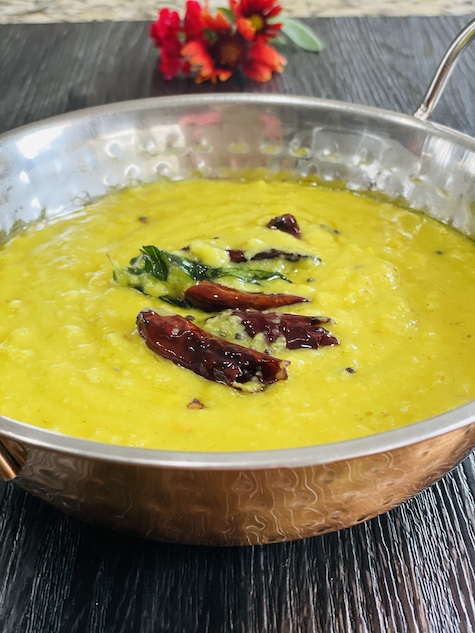
Parippu Or Lentil Curry
Ingredients:
- Split moong dal- 1 cup
- Water- 2 1/2 cups
- Salt- 1 tsp
For grinding:
- Coconut grated- 1 cup
- Green chilies, halved – 2
- Garlic, chopped- 2 cloves
- Turmeric powder-1/4 tsp
- Curry leaves- 1 sprig
- Cumin seeds- 1/2 tsp
For Seasoning:
- Mustard seeds- 1 tsp
- Dried red chilies, halved- 2
- Small pearl onions, chopped- 4
- Curry leaves- 1 sprig
- Ghee- 2 tbsp
Instruction:
- For making Kerala style parippu curry, split moong dal is used.
- In a pressure cooker, cook moong dal with 2 cups water and salt until 2 to 3 whistles.
- Grind the above-mentioned ingredients for grinding in a blender to a smooth paste and keep aside.
- When the dal has cooked, add the ground mixture, and combine everything well.
- Cook over medium heat for 5 minutes until the raw smell of the mixture goes away.
- Add 1/2 to 1 tsp salt.
- Adjust the constituency of the curry by adding 1 cup water, don’t make it too watery.
- Remove the cooker from the heat, keep covered.
Making the Seasoning:
- In a frying pan, heat ghee, as soon as the ghee turns hot, add mustard seeds when it splutters add whole red dry chili, chopped small onion and curry leaves.
- When the onion turns golden brown, remove from the flame.
- Add this seasoning to the Parippu/lentil curry, keep covered.
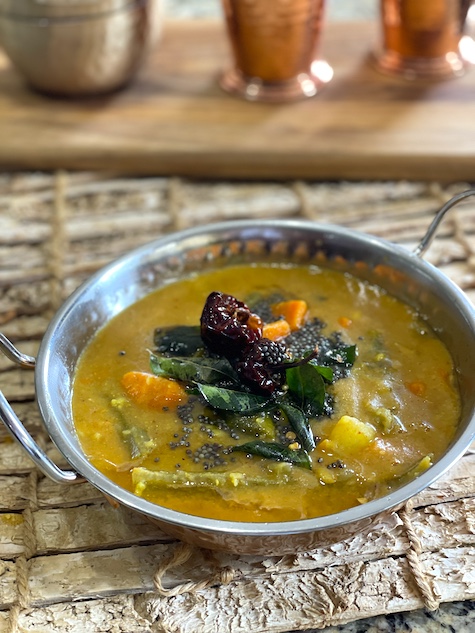
Easy Sambar Without Coconut (Mixed Veggie Curry)- My Mom’s Recipe
Ingredients:
- Toor dal or Sambar lentil- 1 cup
Cooking Veggies:
- Carrots, diced- 2
- Ash gourd, diced- 1
- Eggplant, diced into medium size- 1, (Japanese variety or use half of the American variety)
- Cucumber, deseeded, diced- 1
- Moringa or Drumsticks, fresh-cut long or frozen- 10 (3-inch slices)
- Small pearl onions, whole- 10
- Green chilies, halved vertically- 3
- Curry leaves- 2 sprigs
- Salt- 2 tsp
Spice powders:
- Chili powder- 2 tsp or based on your spice level
- Turmeric powder-1/4 tsp
- Coriander powder-1 1/2 tsp
- Asafoetida- 1/8 tsp
To Roast and Grind:
- Cumin seeds- 1 tsp
- Fenugreek seeds-1/2 tsp
- Coriander seed- 2 tsp
Other Ingredients:
- Fresh Tamarind juice or concentrated paste- for making fresh tamarind juice, soak 3-inch slice tamarind in 1/2 cup lukewarm water
- Water- 1 cup, to thin down the curry
For Seasoning:
- Small pearl onions, chopped small- 4
- Mustard seeds- 1 tsp
- Whole dried red chilies, halved- 2
- Curry leaves- 1 sprig
- Coconut oil- 2 tbsp
Instruction:
- Soak 3-inch slice or gooseberry sized fresh tamarind in 1/2 cup water for 5 minutes.
- After 5 minutes, squeeze the tamarind in water and extract the juice. Keep it aside.
- Cook the toor dal or sambar lentil with enough water (1 1/2 cups water) in a pressure cooker (or in a deep pot) until the dal has cooked well until 2 whistles.
- Cook the veggies along with green chilies, curry leaves and salt in enough water until the veggies have turned soft. Don’t overcook the veggies.
- In a small pan, roast the cumin seeds, fenugreek seeds, and coriander seeds until aromatic and golden in color. Grind these into a fine powder and keep aside.
- When the veggies have turned soft, add the cooked toor dal and combine well.
- Add the roasted ground spice powder along with the other spice powders: chili powder, turmeric powder, coriander powder, and asafoetida.
- Cook for 5 minutes until all the spice powders are well incorporated.
- Add the tamarind juice and more salt.
- Add water if the gravy is thick to thin it down and let the gravy come to a boil.
- Place a small pan over medium heat: add oil, add mustard seeds, and let it splutter, add whole red dry chilies, curry leaves and small onion, saute until the onions turn golden brown in color.
- Pour the seasoning over the cooked Sambar and keep it covered for some time until ready to be served.
Tips:
- Please adjust the spice level, salt and tamarind juice according to your needs.
Sambar or Lentil And Mixed Veggies With Roasted Coconut, For Recipe, Click Here
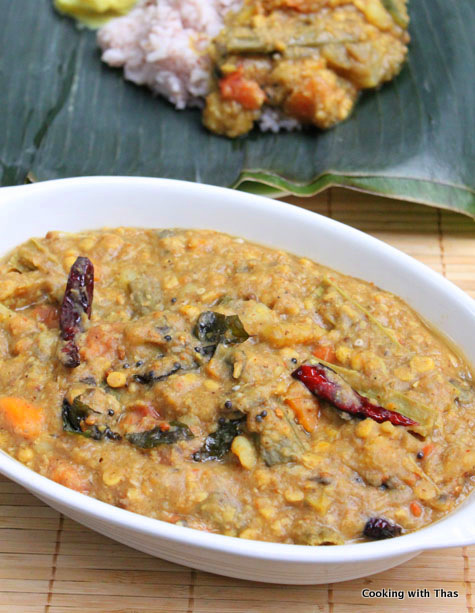
Rasam(Spicy, Tangy Curry)
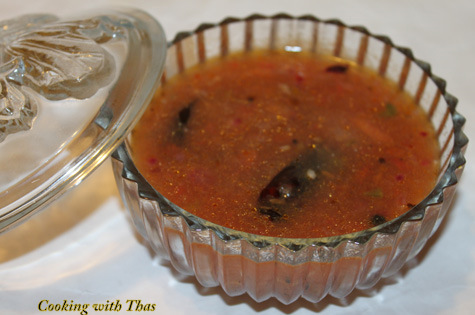
Ingredients:
To Grind:
- Cumin seeds- 1 tsp
- Whole pepper corns-1 tsp
- Ginger, chopped- 1 tsp
- Garlic, chopped- 1 tsp
- Green Chilies, chopped- 3
- Small pearl onions, chopped- 6
- Tomato diced- 1, large
Other ingredients:
- Mustard seeds- 1 tsp
- Curry leaves- 1 sprig
- Tamarind juice- 2-inch slice whole tamarind soaked in 1/2 cup water
- Water- enough to thin down the mixture.
- Salt- 1 1/2 to 2 tsp
- Coconut oil- 2 tbsp
Instruction:
- Soak 3-inch slice or gooseberry sized fresh tamarind in 1/2 cup water for 5 minutes.
- After 5 minutes, squeeze the tamarind in water and strain the juice. Keep it aside.
- Grind the above-mentioned ingredients ‘to grind’ to a coarse paste.
- In a saucepan, add oil, when the oil turns hot, add mustard seeds and let it splutter, add curry leaves and saute for a few seconds.
- Add the coarsely ground paste to the oil, saute until the raw flavor goes away, for 5 minutes.
- Add tamarind juice and add 1 1/2 cups water to thin down the curry.
- Add 1 1/2 to 2 tsp salt based on your needs.
- Let the gravy come to a boil and cook for another 2 to 3 minutes.
- Remove the saucepan from the heat and keep covered.
Tips:
- Please adjust the spice level, salt, and tamarind juice according to your needs.
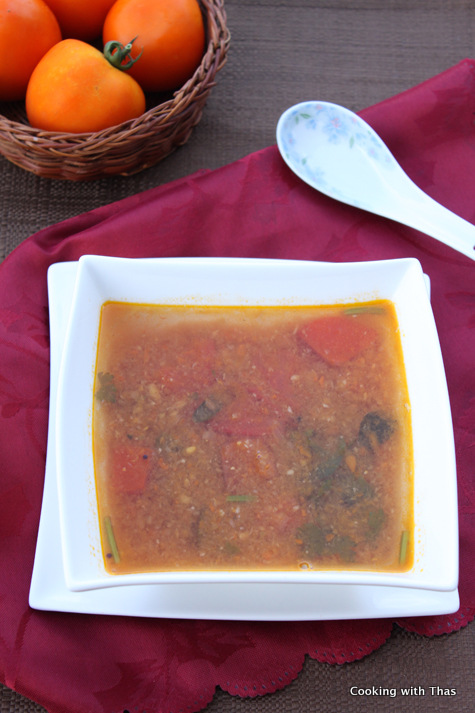
Tomato Rasam- For Recipe Click Here
Pickles
Ingi puli (Ginger-Tamarind Pickle)
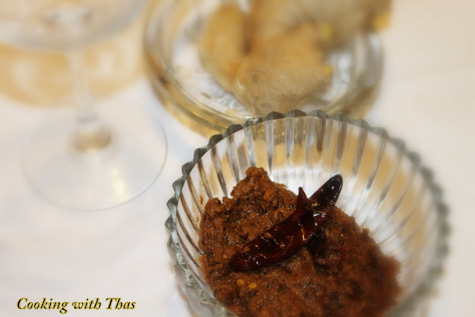
- Ginger sliced to thin rounds- 1 cup
- Oil- 1/2 cup for frying ginger
To Roast & Grind
- Whole red dry chilies- 2
- Coriander seeds- 1 tbsp
- Oil, used for frying ginger- 1 tbsp
Other ingredients
- Tamarind juice- 2-inch fresh tamarind slice soaked in 1/2 cup water
- Asafoetida – 1/8 tsp
- Jaggery or Palm sugar grated- 1 tbsp
- Salt- 1 1/2 tsp
For Seasoning
- Oil, used for frying ginger- 2 tbsp
- Mustard seeds- 1 tsp
- Whole Red dry chili- 2
Instruction:
- Soak 2-inch slice or gooseberry sized fresh tamarind in 1/2 cup water for 5 minutes.
- After 5 minutes, squeeze the tamarind in water and extract the juice.
- Strain the extract. Keep aside.
- Fry the sliced ginger in oil until golden brown. keep aside.
- Heat a frying pan, add 1 tbsp oil used for frying ginger, roast coriander seeds, and whole red chili until they turn golden brown.
- Grind together the fried ginger and the roasted coriander seeds/red chili into a smooth paste. Add 1 to 2 tbsp water while grinding.
- In a saucepan, add 2 tbsp oil used for frying ginger, add the mustard seeds let it splutter.
- Add whole red chilies and add the ground mixture, saute in the oil.
- Add 1 to 1 1/2 tsp salt.
- Add tamarind juice and asafoetida, let the mixture come to a boil.
- Add the jaggery and combine everything well. Cook for 2 minutes.
- Remove from the heat and let cool down.
Tips:
- This dish is supposed to be spicy and tangy.
- Store this in an air-tight container and refrigerate for about 2-3 weeks.
Mango Pickle
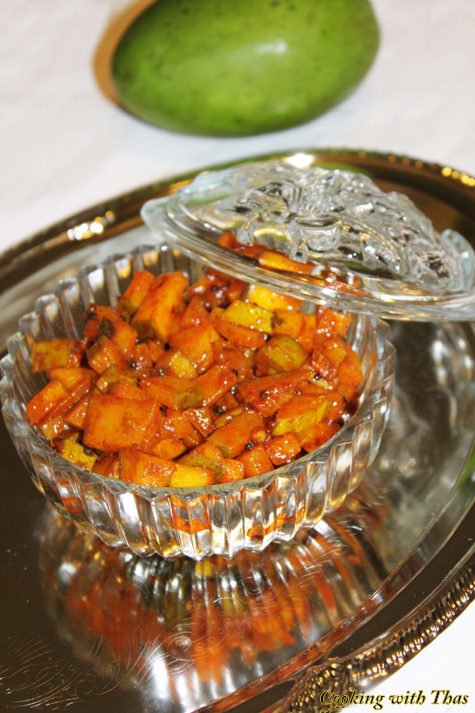
Ingredients:
- Raw mango chopped small- 1, large
- Ginger, thinly sliced- 2 tbsp
- Mustard seeds- 1 tsp
- Curry leaves- 1 sprig
- Chili powder- 1 tbsp
- Turmeric powder- 1/2 tsp
- Asafoetida- 1/4 tsp
- Salt- 3/4 tsp
- Vinegar- 2 tbsp
- Sesame oil or vegetable oil- 2 tbsp
Instruction:
- Fry the ginger in enough oil till golden brown in color.
- In a wide pan, add the sesame oil, when it turns hot, add the mustard seeds and let it splutter.
- Add curry leaves, chili powder, turmeric powder, asafoetida, salt and saute in the oil.
- As soon as the spices start to brown, add the mangoes and fried ginger.
- Combine everything well and finally add the vinegar; saute for 2 minutes.
- Remove the pan from the heat and let cool down.
- Store this an air-tight container and refrigerate for a few weeks.
Tips:
- Adjust the spice level according to your needs.
Gooseberry Pickle- Nellikka Achar, For Recipe Click Here
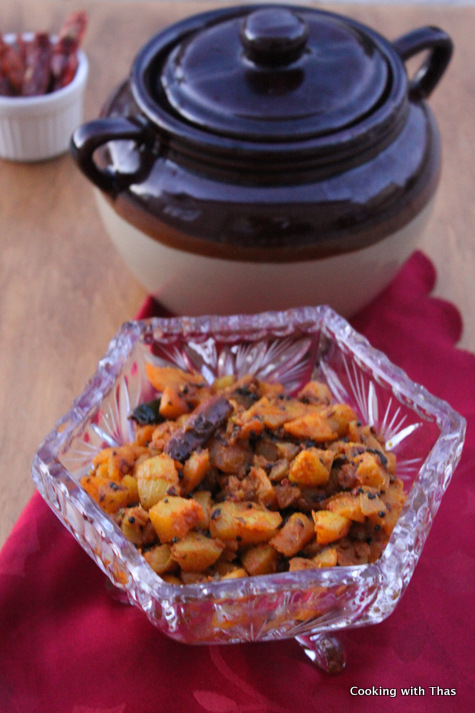
Side Dishes
Okra in yogurt or Lady’s finger Kichadi (Vendakka Kichadi)
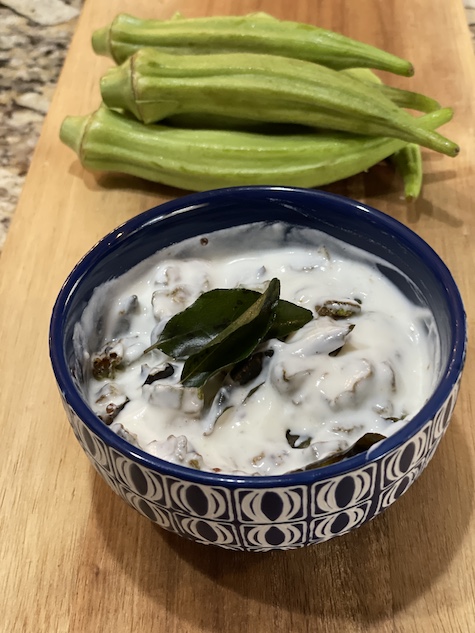
Ingredients:
- Lady’s finger or Okra, cut lengthwise and chopped small- 15
- Green chilies, chopped – 2
- Curry leaves- 1 sprig
- Yogurt or Curd- 1 cup
- Salt- 1/2 tsp
- Oil for frying Okra
Instruction:
- In a wide pan, heat oil, add lady’s finger, green chilies, and curry leaves.
- Fry until okra turns golden brown.
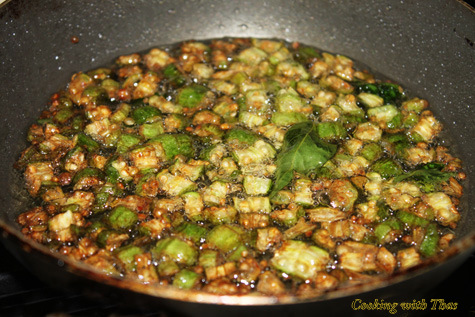
- Transfer to a plate lined with a paper towel.
- In a medium bowl, whisk the yogurt well with a spoon, add fried lady’s finger, 1/2 tsp salt; combine well.
Beetroot Pachadi
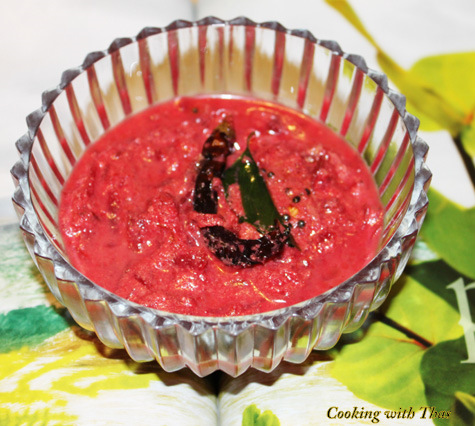
Ingredients:
- Beetroot grated- 1, large
- Turmeric powder- 1/4 tsp
- Salt – 1 tsp
- Water- 1/2 cup
To Grind:
- Coconut grated- 1/2 cup
- Mustard seeds- 1/2 tsp
- Green chilies, chopped- 1
- Cumin seeds-1/4 tsp
- Ginger chopped-1/2 tsp
- Water- 1/2 cup
Other ingredients:
- Yogurt or Curd- 1/2 cup
For Seasoning:
- Coconut Oil- 1 tbsp
- Mustard seeds- 1 tsp
- Whole red chilies- 2
- Curry leaves- 1 sprig
Instruction:
- Place a saucepan over medium heat, add grated beetroot along with turmeric powder, salt, and water, cook until the beetroot turns soft; about 10 minutes.
- Grind all the above-mentioned ingredients ‘to grind’ in a blender to a smooth paste.
- Add the ground coconut paste to the cooked beetroot. Rinse the blender jar with 1/2 cup water & add that.
- Cook for 5 minutes till the raw smell goes away and the mixture has thickened.
- Lower the heat and add the thick yogurt/curd to the above mixture stirring constantly.
- Taste and add more salt if required.
- Mix everything till yogurt has incorporated well, cook for 2 minutes.
- Remove the pan from the heat and keep aside covered.
- Make tempering: Place a pan over medium heat, add coconut oil, let oil turn hot.
- Add mustard seeds, let it splutter.
- Add whole red chilies and curry leaves, saute for a few seconds.
- Add the tempering to the cooked Beetroot pulissery, close the pan with its lid, keep covered for some time.
Mango in Coconut & Yogurt or Mambazha Pulissery
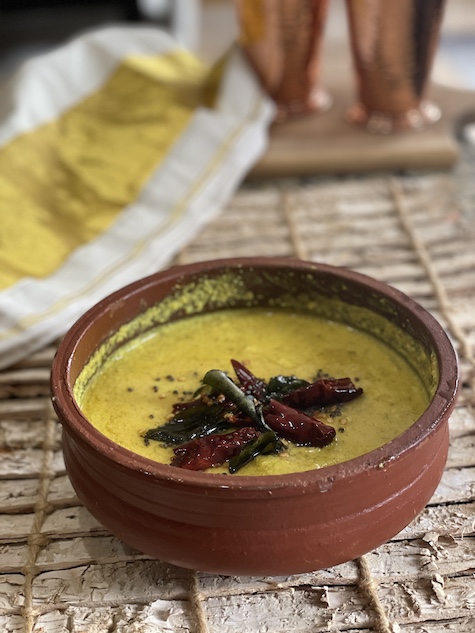
Ingredients:
- Ripe mangoes, diced- 2
- Turmeric powder-1/2 tsp
- Red Chili powder-1/2 tsp
- Water- 1 cup
- Salt-1 tsp
To Grind:
- Coconut grated- 1 cup
- Cumin seeds- 1/2 tsp
- Turmeric powder-1/4 tsp
- Green chilies chopped- 1
- Curry leaves- 1 sprig
- Water- 1/2 cup
After cooking:
- Thick yogurt/Curd- 1 cup
For tempering:
- Coconut oil- 1 tbsp
- Fenugreek seeds- 1/4 tsp
- Whole red chilies-2
- Curry leaves- 1 sprig
- Mustard seeds- 1 tsp
Instruction:
- Use ripe sweet mangoes & cut them into large chunks. If using small mangoes, you can add the whole mangoes.
- To a saucepan, add mangoes along with red chili powder, turmeric powder, salt & water.
- Cook covered until the mangoes turn soft. Don’t overcook the mangoes & let it turn mushy.
- Grind the above-mentioned ingredients ‘to grind’ to a smooth paste.
- Add the ground paste to the cooked mangoes. Rinse the blender jar with 1/2 cup water & add that.
- Cook over medium heat until the raw smell of the ground coconut goes away, for 5 minutes.
- Taste and add more salt if required.
- Take the pan off the heat, let cool down a bit, add 1 cup yogurt/Curd and combine well until well incorporated.
- After adding yogurt, don’t cook it, the gravy will curdle.
- Close with a lid & keep aside.
Preparing the tempering:
- In a small pan, heat coconut oil, add mustard seeds and let splutter, add whole red chilies, curry leaves and finally add fenugreek seeds.
- Saute in oil for a couple of seconds, don’t let the fenugreek seeds turn brown.
- Immediately pour the tempering over the Mango pulissery and keep it covered for sometime.
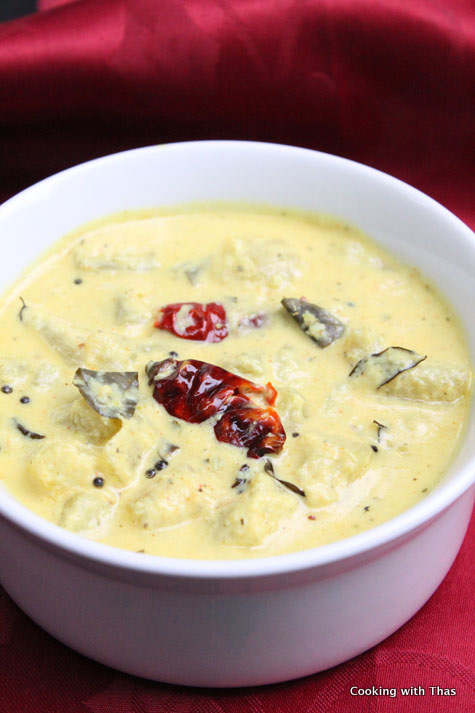
Cucumber Pulissery Or Cucumber In Coconut And Yogurt, For Recipe Click Here
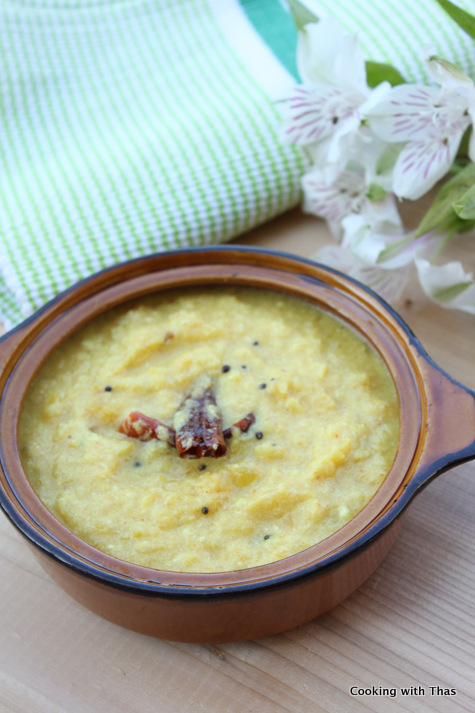
Pineapple Pulissery Or Pineapple In Coconut And Yogurt, For Recipe Click Here
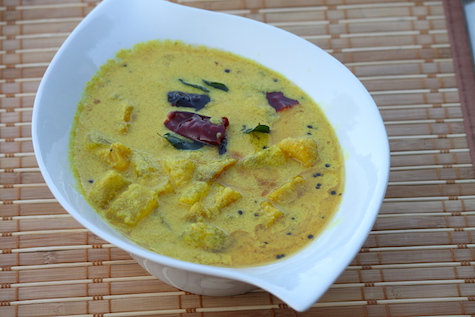
Kalan Recipe
Ingredients:
- Ripe plantain, cut small- 1/2 cup (not too ripe plantain)
- Ash gourd, cut small- 3/4 cup
- Green chilies chopped- 1
- Turmeric powder- 1/4 tsp
- Red chili powder- 1/4 tsp
- Water- enough to cook veggies
- Salt – 1/2 to 1 tsp
- Yogurt/Curd- 3/4 cup
To Grind:
- Coconut grated- 1/2 cup
- Green chilies chopped- 1
- Garlic minced- 1/2 tsp
- Cumin seeds- 1/4 tsp
- Turmeric powder-1/4 tsp
- Curry leaves- 1 sprig
- Salt- 1/2 tsp
- Water- 1/2 cup
For Seasoning:
- Coconut oil- 1 tbsp
- Mustard seeds- 1 tsp
- Whole dry red chilies- 2
- Fenugreek seeds- 1/4 tsp
- Curry leaves- 1 sprig
Instruction:
- In a saucepan, cook ripe plantain/ash gourd in 1 cup water along with green chilies, turmeric powder, red chili powder, and salt, until the veggies turn soft.
- Grind the above-mentioned ingredients ‘to grind’ to a smooth paste.
- Add the ground coconut to the cooked veggies. Rinse the blender jar with 1/2 cup water and add that.
- Cook for 5 minutes.
- Remove the saucepan from the heat, add 3/4 cup thick curd, and combine everything.
- Return the pan back to stove over low flame, stirring constantly for a couple of minutes.
- Place a frying pan over medium heat, add the oil, add mustard seeds, let it splutter, add red chilies, curry leaves and finally fenugreek seeds and saute for a second.
- Pour the seasoning over the kalan. Cover with the lid and let cool down.
Olan Recipe Or Black Eyed Beans In Coconut Gravy
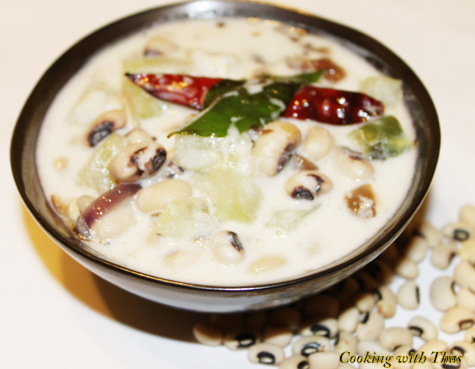
Ingredients:
- Black-eyed beans- 1/2 cup
- Ash gourd, cut small- 1 1/2 cups
- Water, to cook beans- 1 1/2 cups
- Green chilies- 3
- Cumin seeds- 1/4 tsp
- Thin coconut milk- 3/4 cup
- Thick coconut milk- 1/2 cup
- Salt – 1 1/2 tsp
For seasoning:
- Coconut oil- 1 tbsp
- Mustard seeds- 1 tsp
- Small pearl onions chopped – 3
- Curry leaves- 1 sprig
Instruction:
- Soak the black-eyed beans for 4 hrs and pressure cook with 1 1/2 cups water and salt for 2 whistles or until cooked through.
- In a saucepan, cook ash gourd along with green chilies, cumin powder, and salt in 1/2 cup water.
- Add the cooked beans to the cooked ash gourd and add 3/4 cup thin coconut milk, combine, and cook for 5 minutes.
- Now add 1/2 cup thick coconut milk, add salt if needed and combine everything gently. Cook for 3 minutes.
- If the mixture is thin, you could add 1 tbsp corn starch mixed with 1 tbsp cold water.
Making the seasoning:
- In a small pan, heat coconut oil, add mustard seeds, let it splutter. Add small onions and curry leaves.
- Saute until onion turns golden brown and remove from the flame.
- Add this seasoning to the above cooked beans and ash gourd mixture. Cover with its lid and let cool down.
Thoran (Veggie Stir Fry)
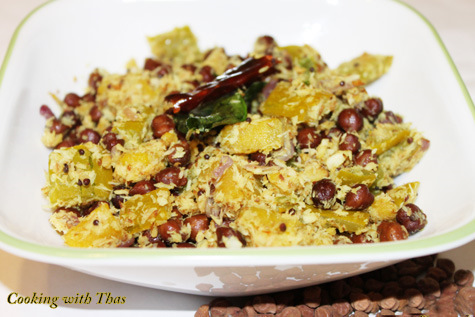
Ingredients:
- Beans, cut small- 1 cup
- Ash gourd, diced small- 1/2 cup
- Black chickpeas (optional)- 1/2 cup, cooked in water
- Water- 1/2 cup
- Green chilies, chopped- 1
- Mustard seeds- 1 tsp
- Whole red chilies-2
- Curry leaves- 1 sprig
- Coconut oil- 1 tbsp
To Grind
- Coconut grated- 1/2 cup
- Turmeric powder- 1/4 tsp
- Garlic minced- 1/2 tsp
- Cumin seeds- 1/2 tsp
Instruction:
- Soak 1/2 cup black chick peas in water for 2 hours.
- Drain the water, cook the chickpeas along with 1 cup water in a pressure cooker until soft for 2 whistles.
- Grind the above-mentioned ingredients ‘to grind’ to a coarse paste.
- In a wide skillet, heat the oil, add mustard seeds and let it splutter.
- Add whole red chilies, curry leaves and saute for a second.
- To this add beans, ash gourd, and green chilies. Add 1/2 cup water and cook covered.
- When the veggies turn soft, add the cooked black chickpeas and ground coconut, cook for 5 minutes.
- Stir fry the veggies for a few minutes and let all the water evaporate. Let coconut turn golden brown.
- Remove the pan from the heat and keep covered.
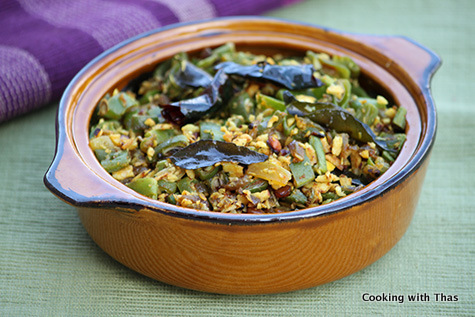
Green Beans Poriyal, For Recipe Click Here
Avial (Mixed Veggies in Yogurt)
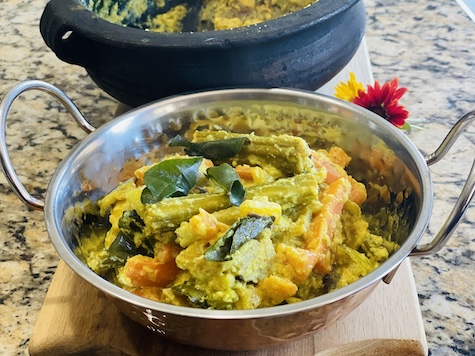
Ingredients:
- Carrot, cut into thin wedges- 2
- Cucumber, deseeded and cut into thin wedges-1
- Egg plant, cut into wedges-1
- Ash gourd, cut into thin wedges- 1 cup
- Raw plantain, cut into thin wedges- 1/2 of a plantain
- Green chilies, halved- 2
- Turmeric powder- 1/2 tsp
- Curry leaves- 1 sprig
- Water- 1 cup
- Salt- 1 tsp
To Grind:
- Coconut grated- 1 cup
- Cumin seeds- 1 tsp
- Small onions, chopped- 3
- Curry leaves- 1 sprig
- Tamarind whole or tamarind concentrate- 2-inch slice if using whole tamarind (or 1/2 tsp tamarind concentrated paste)
- Water- 1/2 cup
Other Ingredients:
- Yogurt or curd- 1/2 cup
- Coconut oil- 2 tbsp
Instruction:
- In a deep saucepan, cook all the above-mentioned veggies along with green chilies, turmeric powder, salt, and curry leaves in 1 cup water, until the veggies turn soft. Do not overcook the veggies.
- Grind the above-mentioned ingredients ‘to grind’ to a coarse mixture and keep aside.
- After the veggies have turned soft, add the ground mixture, cook for 5 minutes.
- Taste and add 1/2 to 1 tsp salt.
- Turn the heat to low and add the yogurt/curd, gently mix everything. Cook for 2 minutes.
- Remove the pan from the heat.
- Finally, drizzle the coconut oil and cover the saucepan with the lid to preserve the aroma.
Avial With Raw Mango, For Recipe Click Here

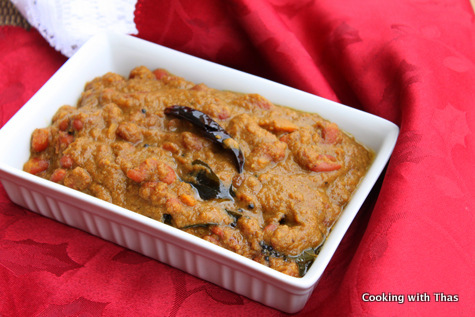
Erissery: Pumpkin And Red beans In Roasted Coconut Gravy, For recipe, click here
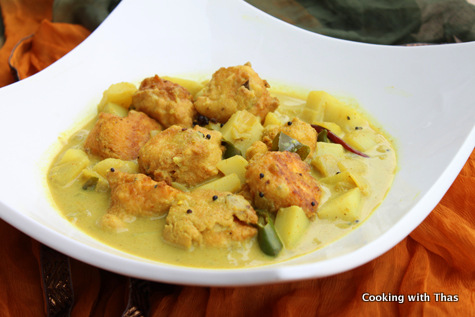
Vada Kootucurry: Fried Lentil Dumplings In Coconut Gravy, For Recipe, Click Here
Snacks
Plantain chips

Ingredients:
- Raw plantain cut into thin rounds- 1
- Turmeric powder- 1/4 tsp
- Salt- 1/2 tsp
- Vegetable oil for frying- 1 cup or enough for deep frying
Instruction:
- Peel off the skin from the raw plantain and slice into thin rounds.
- In a deep frying pan, heat oil, when the oil gets hot enough, add the plantains and fry it.
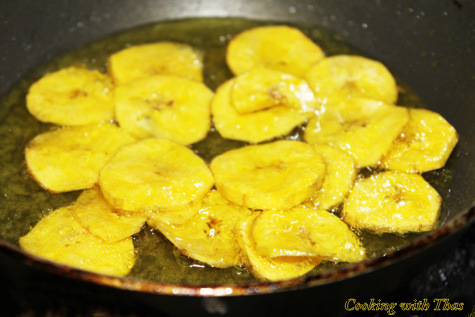
- Combine turmeric powder and salt with 1 tbsp water.
- In the middle of frying add 1 tsp of turmeric powder/water into the frying plantains and give a stir.
- Fry until golden brown and using a slotted spoon, transfer the chips into a paper towel, let drain the excess oil.
Tips:
- You can store the chips in an airtight container for few days.
Fried Plantain coated in jaggery syrup or Upperi

Ingredients:
- Raw plantain, cut lengthwise and diced 1/2 inch thick- 2
- Vegetable oil- enough for deep frying
For syrup:
- Crushed Jaggery or Palm sugar- 3/4 cup
- Water- 2 tbsp
- Ginger powder- 1 tsp
- Cumin powder- 1 tsp
Other ingredients:
- Powdered sugar- 2 tbsp
Instruction:
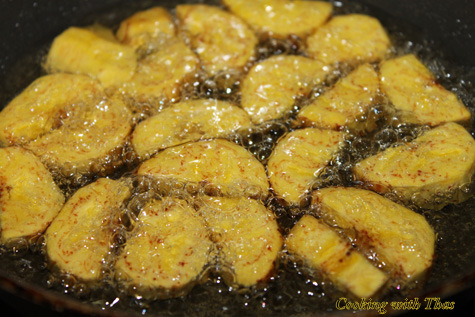
- Heat a deep frying pan, add oil. Let the oil turn hot. Add plantains and deep fry in oil.
- Transfer to a plate lined with a paper towel.
Making the syrup:
- In a saucepan, add the crushed jaggery, water, let the jaggery dissolve in water.
- Add ginger powder and cumin powder to the jaggery, combine well.
- When the jaggery starts to thicken, add the fried plantain, and stir to coat the syrup evenly on the fried plantain.
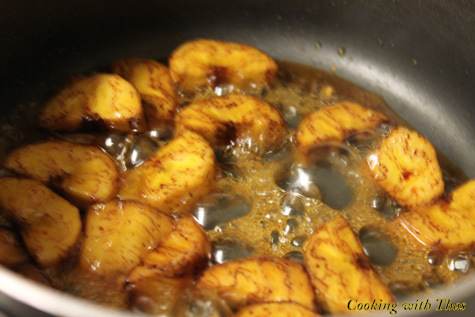
- Remove the pan from the heat and immediately add powdered sugar and combine well.
- Transfer to a bowl and let cool down.
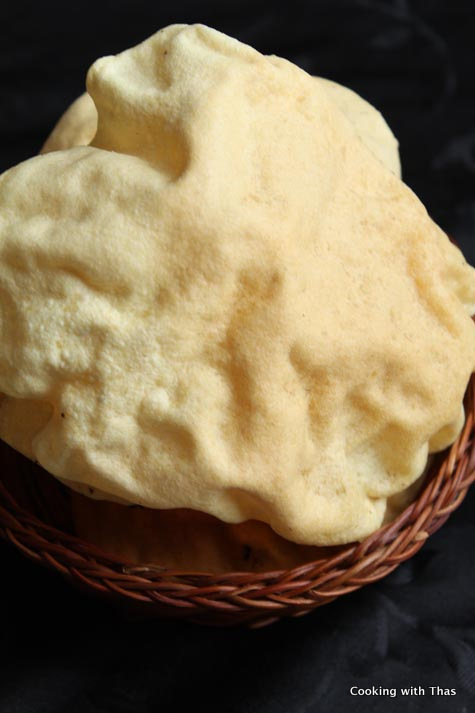
Indian Lentil Wafers Or Pappadam
Ingredients:
- Pappadam- 1 packet or depending upon how many you need
- Vegetable oil – enough for frying
Instruction:
- In a deep frying pan, heat the oil and put the pappadam into the oil.
- It will bubble up immediately.
- Using a slotted spoon, flip to the other side and fry for less than a second.
- Remove from the oil and transfer into a paper towel.
- This should be made just before serving the meal and should be kept in an air tight container. Pappadam when kept uncovered would loose its crispiness.
Desserts
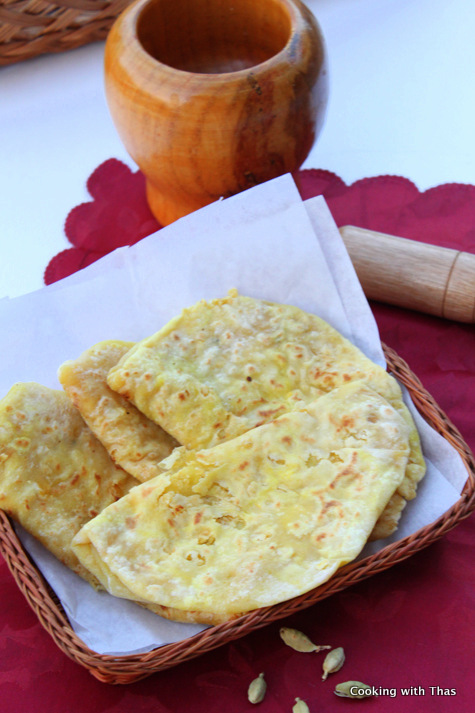
Sweet Boli Or Pooran Poli, For Recipe, Click Here
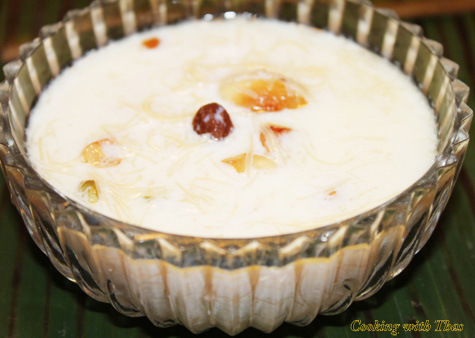
Vermicelli In Sweetened Milk Or Semiya Payasam
Ingredients:
- Vermicelli- 1/2 cup
- Milk- 3 1/2 cups
- Sweetened condensed milk- 3/4 of 14 oz can
- Cardamom powder- 1/4 tsp
- Ghee- 2 tbsp + 2 tbsp
- Cashew nuts- 15
- Raisins- 2 tbsp
Instruction:
- Roast the vermicelli in 2 tbsp ghee until aromatic and golden in color, keep aside.
- Place a saucepan over medium heat, add the milk and roasted vermicelli, let the vermicelli cook in milk until soft.
- Add the condensed milk stirring constantly.
- Add the cardamom powder.
- Combine everything, let come to a boil.
- Lower the heat and simmer for 3 minutes.
- In a small frying pan, add 2 tbsp ghee; roast cashew nuts, and raisins.
- Add the roasted cashew nuts and raisins to the payasam. Keep covered for some time.
- Serve the payasam in dessert bowls and enjoy.
Tips:
- Leftover payasam can be chilled, tastes really tasty the next day.
- You can adjust the sweetness of the payasam by adding more or less condensed milk.
Ada Pradhaman Or Rice Pasta Payasam, For Recipe, Click Here
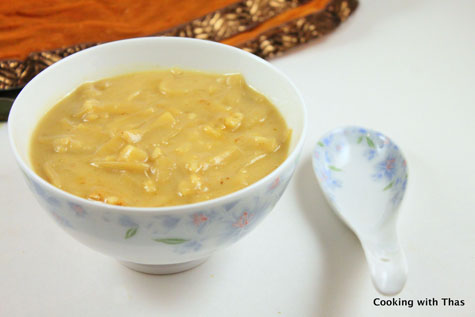
Carrot Payasam or Carrot in Sweetened Milk, For Recipe, Click Here
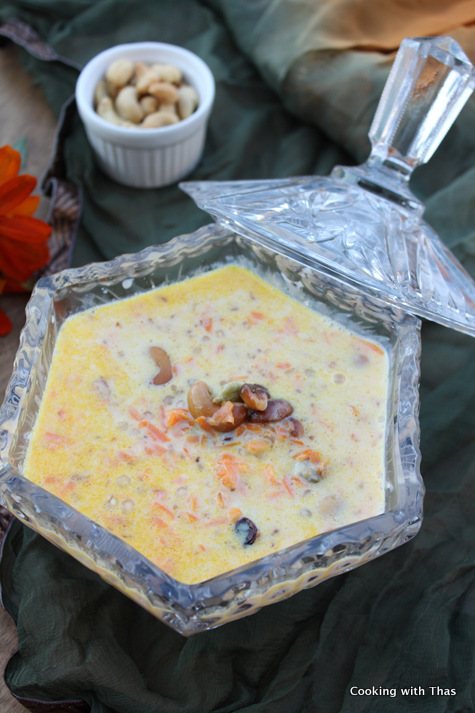
Dates Payasam, For recipe Click Here
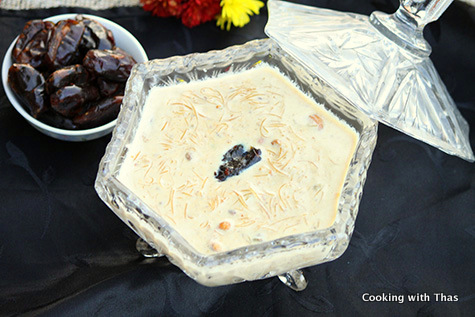
Mango Payasam, For Recipe Click Here
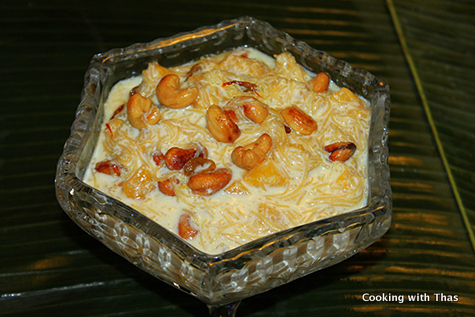
Aval Or Flattened Rice Payasam, For Recipe Click Here
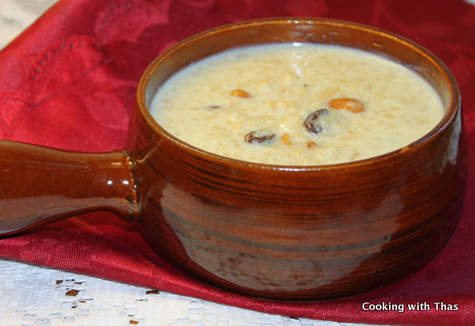
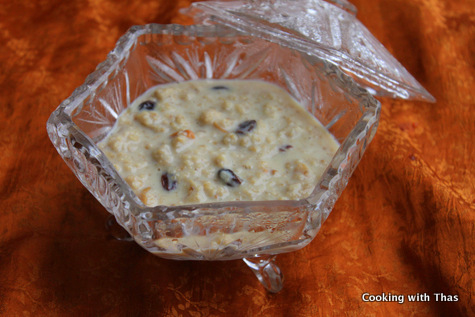
Oats and Dried Nuts Payasam, For Recipe Click Here
How to serve Sadya on a Banana leaf:
- On the top side of the banana leaf away from the person sitting in front of it, serve one banana, snacks, pickles and side dishes in a line.
- On the other side of the leaf, first course served will be Rice with Parippu and little ghee.
- Second course will be: Sambar along with more Rice.
- Third course will be: Rice with Rasam.
- Fourth course will be: Rice with Beaten yogurt or Moru
- In the final round dessert is served on the same banana leaf depending upon how many payasams you have, it is served one by one starting with the Vermicelli Payasam.
Devour each and every dish and don’t be ashamed to lick your fingers at the end, which you’ll do even without your knowledge 😉
- Split Moong dal- 1 cup
- Water- 2½ cups
- Salt- 1 tsp
- Coconut grated- 1 cup
- Green chilies- 2
- Garlic, chopped- 2 cloves
- Turmeric powder-1/4 tsp
- Curry leaves- 1 sprig
- Cumin seeds- ½ tsp
- Mustard seeds- 1 tsp
- Dried red chilies, halved- 2
- Small pearl onions, minced- 4
- Curry leaves- 1 sprig
- Ghee- 2 tbsp
- For making Kerala parippu curry, splt moong dal is used.
- In a pressure cooker, cook moong dal with water and salt until 2 to 3 whistles.
- Grind the above-mentioned ingredients for grinding in a blender to a smooth paste and keep aside.
- When the dal has cooked, add the ground mixture, and combine everything well.
- Cook over medium heat for 5 minutes until the raw smell of the mixture goes away.
- Add ½ to 1 tsp salt.
- Adjust the constituency of the curry by adding 1 cup water, don't make it too watery.
- Remove the cooker from the heat, keep covered.
- In a frying pan, heat ghee, as soon as the ghee turns hot, add mustard seeds when it splutters add whole red dry chili, chopped small onion and curry leaves.
- When the onion turns golden brown, remove from the flame.
- Add this seasoning to the Parippu/lentil curry, keep covered.
- Toor dal or Sambar lentil- 1 cup
- Carrots, diced- 2
- Ash gourd, diced- 1
- Eggplant, diced- 1, (Japanese variety or use half of the American variety)
- Cucumber, deseeded, diced- 1
- Moringa or Drumsticks, fresh-cut long or frozen- 10 (3-inch slices)
- Small pearl onions, whole- 10
- Green chilies, halved vertically- 3
- Curry leaves- 2 sprigs
- Salt- 2 tsp
- Chili powder- 2 tsp or based on your spice level
- Turmeric powder-1/4 tsp
- Coriander powder-1½ tsp
- Asafoetida- 1/8 tsp
- Cumin seeds- 1 tsp
- Fenugreek seeds-1/2 tsp
- Coriander seed- 2 tsp
- Fresh Tamarind juice or concentrated paste- for making fresh tamarind juice, soak 3-inch slice tamarind in ½ cup lukewarm water
- Water- 1 cup, to thin down the curry
- Small pearl onions, chopped small- 4
- Mustard seeds- 1 tsp
- Whole dried red chilies, halved- 2
- Curry leaves- 1 sprig
- Coconut oil- 2 tbsp
- Soak 3-inch slice or gooseberry sized fresh tamarind in ½ cup water for 5 minutes.
- After 5 minutes, squeeze the tamarind in water and extract the juice. Keep it aside.
- Cook the toor dal or sambar lentil with enough water (1½ cups water) in a pressure cooker (or in a deep pot) until the dal has cooked well until 2 whistles.
- Cook the veggies along with green chilies, curry leaves and salt in enough water until the veggies have turned soft. Don't overcook the veggies.
- In a small pan, roast the cumin seeds, fenugreek seeds, and coriander seeds until aromatic and golden in color. Grind these into a fine powder and keep aside.
- When the veggies have turned soft, add the cooked toor dal to this and combine well.
- Add the roasted ground spice powder along with the other spice powders: chili powder, turmeric powder, coriander powder, and asafoetida.
- Cook for 5 minutes until all the spice powders are well incorporated.
- Add the tamarind juice and more salt if required.
- Add 1 cup water if the gravy is thick to thin it down and let the gravy come to a boil.
- Place a small pan over medium heat: add oil, add mustard seeds and let it splutter, add whole red dry chilies, curry leaves and small onion, saute until the onions turn golden brown in color.
- Pour the seasoning over the cooked Sambar and keep covered for sometime until ready to be served.
- Cumin seeds- 1 tsp
- Whole pepper corns-1 tsp
- Ginger, chopped- 1 tsp
- Garlic, chopped- 1 tsp
- Green Chilies, chopped- 3
- Small pearl onions, chopped- 6
- Tomato diced- 1, large
- Mustard seeds- 1 tsp
- Curry leaves- 1 sprig
- Tamarind juice- 2 inch slice whole tamarind soaked in 4 tbsp water, mash it and strain the juice
- Water- enough to thin down the mixture.
- Salt-1½ to 2 tsp
- Coconut oil- 2 tbsp
- Soak 3-inch slice or gooseberry sized fresh tamarind in ½ cup water for 5 minutes.
- After 5 minutes, squeeze the tamarind in water and extract the juice.
- Strain the extract. Keep aside.
- Grind the above-mentioned ingredients 'to grind' to a coarse paste.
- In a saucepan, add oil, when the oil turns hot, add mustard seeds and let it splutter, add curry leaves and saute for a few seconds.
- Add the coarse ground paste to the oil, saute until the raw flavor goes away, 5 minutes.
- Add tamarind juice and add 1½ cups water to thin down the curry.
- Add 1½ to 2 tsp salt based on your needs.
- Let the gravy come to a boil and cook for another 2 to 3 minutes.
- Remove the saucepan from the heat and keep covered.
- Ginger sliced to thin rounds- 1 cup
- Whole red dry chilies- 2
- Coriander seeds- 1 tbsp
- Oil, used for frying ginger- 1 tbsp
- Tamarind juice- 3-inch fresh tamarind slice soaked in ½ cup water
- Asafoetida – ⅛ tsp
- Jaggery or Palm sugar grated- 1 tbsp
- Salt- 1½ tsp
- Oil, used for frying ginger- 2 tbsp
- Mustard seeds- 1 tsp
- Whole Red dry chili- 2
- Soak 2-inch slice or gooseberry sized fresh tamarind in ½ cup water for 5 minutes.
- After 5 minutes, squeeze the tamarind in water and extract the juice.
- Strain the extract. Keep aside.
- Fry the sliced ginger in oil until golden brown. keep aside.
- Heat a frying pan, add 1 tbsp oil used for frying ginger, roast coriander seeds, and whole red chili until they turn golden brown.
- Grind together the fried ginger and the roasted coriander seeds/red chili into a smooth paste. Add 1 to 2 tbsp water while grinding.
- In a saucepan, add 2 tbsp oil used for frying ginger, add the mustard seeds let it splutter.
- Add whole red chilies and add the ground mixture, saute in the oil.
- Add 1 to 1½ tsp salt.
- Add tamarind juice and asafoetida, let the mixture come to a boil.
- Add the jaggery and combine everything well. Cook for 2 minutes.
- Remove from the heat and let cool down.
Store this in an air-tight container and refrigerate for about 2-3 weeks.
- Raw mango diced into small cubes- 1, large
- Ginger, thinly sliced- 2 tbsp
- Mustard seeds- 1 tsp
- Curry leaves- 1 sprig
- Chili powder- 1 tbsp
- Turmeric powder- ½ tsp
- Asafetida- ¼ tsp
- Salt- ¼ tsp
- Vinegar- 2 tbsp
- Sesame oil or vegetable oil- 2 tbsp
- Fry the ginger in enough oil till golden brown in color.
- In a wide pan, add the sesame oil, when it turns hot, add the mustard seeds and let it splutter.
- Add curry leaves, chili powder, turmeric powder, asafoetida, salt and saute in the oil.
- As soon as the spices start to brown, add the mangoes and fried ginger.
- Combine everything well and finally add the vinegar; saute for 2 minutes.
- Remove the pan from the heat and let cool down.
- Store this an air-tight container and refrigerate for a few weeks.
- Lady's finger, cut lengthwise and chopped small- 15
- Green chili, chopped - 2
- Curry leaves- 1 sprig
- Yogurt or Curd- 1 cup
- Salt- ½ tsp
- Oil for frying Okra
- In a frying pan, heat oil; add lady's finger, green chilies and curry leaves.
- Transfer to a plate lined with a paper towel.
- In a medium bowl, whisk the yogurt well with a spoon, add fried lady's finger, ½ tsp salt; combine well.
- Beetroot grated- 1, large
- Turmeric powder- ¼ tsp
- Salt - 1 to 1½ tsp
- Water- ¾ cup
- Coconut grated- ¾ cup
- Mustard seeds- ½ tsp
- Green chilies chopped- 1
- Cumin seeds-1/4 tsp
- Ginger chopped-1/2 tsp
- Water- ½ cup
- Yogurt or Curd: 1¾ cups
- Mustard seeds- 1 tsp
- Whole red chilies- 2
- Curry leaves- 1 sprig
- Coconut Oil- 1 tbsp
- Place a saucepan over medium heat, add grated beetroot along with turmeric powder, salt, and water, cook until the beetroot turns soft; about 10 minutes.
- Grind all the above-mentioned ingredients ‘to grind’ in a blender to a smooth paste.
- Add the ground coconut paste to the cooked beetroot. Rinse the blender jar with ½ cup water & add that.
- Cook for 5 minutes till the raw smell goes away and the mixture has thickened.
- Taste and add more salt if required.
- Lower the heat and add the thick yogurt/curd to the above mixture stirring constantly.
- Mix everything till yogurt has incorporated well, cook for 2 minutes.
- Remove the pan from the heat and keep aside covered.
- Make tempering: Place a pan over medium heat, add coconut oil, let oil turn hot.
- Add mustard seeds, let it splutter.
- Add whole red chilies and curry leaves, saute for a few seconds.
- Add the tempering to the cooked Beetroot/yogurt mixture, close the pan with its lid, keep covered for some time.
- Ripe mangoes, diced- 2
- Turmeric powder-1/2 tsp
- Red Chili powder-1/2 tsp
- Water- 1 cup
- Thick yogurt/Curd- 1 cup
- Salt- 1 to 1½ tsp
- Coconut grated- 1 cup
- Yogurt/Curd- 1 cup
- Cumin seeds- ½ tsp
- Turmeric powder-1/4 tsp
- Green chilies chopped- 1
- Curry leaves- 1 sprig
- Water- ½ cup
- Mustard seeds- 1 tsp
- Fenugreek seeds- ¼ tsp
- Whole red chilies-2
- Curry leaves- 1 sprig
- Coconut oil- 1tbsp
- In a saucepan, cook mango in 1 cup water along with red chili powder, turmeric powder, and salt until the mangoes turn soft. Don't let it turn mushy.
- Grind the above-mentioned ingredients 'to grind' with 1 cup yogurt into a smooth paste.
- Add the ground paste to the cooked mangoes. Rinse the blender jar with ½ cup water & add that.
- Cook for 5 minutes until the raw smell of the ground paste goes away in medium flame.
- Taste and add more salt if required.
- Lower the heat and add the remaining 1 cup yogurt/Curd and combine well. Cook for 2 minutes.
- Preparing the seasoning:
- In a pan, heat coconut oil, add mustard seeds and let it splutter, add whole red chilies, curry leaves and finally add fenugreek seeds.
- Saute in oil for a couple of seconds and remove the pan from the heat.
- Add the above seasoning to the Mango pulissery and keep covered.
- Ripe plantain, cut small- ½ cup
- Ash gourd, cut small- ¾ cup
- Green chilies chopped- 1
- Turmeric powder- ¼ tsp
- Red chili powder- ¼ tsp
- Water- 1 cup
- Salt - ½ to 1 tsp
- Yogurt/Curd- ¾ cup
- Coconut grated- ½ cup
- Green chilies chopped- 1
- Garlic minced- ½ tsp
- Cumin seeds- ¼ tsp
- Turmeric powder-1/4 tsp
- Curry leaves- 1 sprig
- Salt- ½ tsp
- Water- ½ cup
- Coconut oil- 1tbsp
- Mustard seeds- 1 tsp
- Whole dry red chilies- 2
- Fenugreek seeds- ¼ tsp
- Curry leaves- 1 sprig
- In a saucepan, cook ripe plantain/ash gourd in 1 cup water along with green chilies, turmeric powder, red chili powder, and salt, until the veggies turn soft.
- Grind the above-mentioned ingredients 'to grind' to a smooth paste.
- Add the ground coconut to the cooked veggies. Rinse the blender jar with ½ cup water and add that.
- Cook for 5 minutes.
- Remove the saucepan from the heat, add ¾ cup thick curd, and combine everything.
- Return the pan back to stove over low flame, stirring constantly for a couple of minutes.
- Place a frying pan over medium heat, add the oil, add mustard seeds, let it splutter, add red chilies, curry leaves and finally fenugreek seeds and saute for a second.
- Pour the seasoning over the kalan. Cover with the lid and let cool down.
- Black eyed beans- ½ cup
- Ash gourd, cut small- 1½ cups
- Water, to cook beans- 1½ cups
- Green chilies- 3
- Cumin seeds- ¼ tsp
- Thin coconut milk- ¾ cup
- Thick coconut milk- ½ cup
- Salt - 1½ tsp
- Coconut oil- 1 tbsp
- Mustard seeds- 1 tsp
- Small onion chopped -3, small
- Curry leaves- 1 sprig
- Soak the black-eyed beans for 4 hrs and pressure cook with 1½ cups water and salt for 2 whistles or until cooked through.
- In a saucepan, cook ash gourd along with green chilies, cumin powder, and salt in ½ cup water.
- Add the cooked beans to the cooked ash gourd and add ¾ cup thin coconut milk, combine, and cook for 5 minutes.
- Now add ½ cup thick coconut milk, add salt if needed and combine everything gently. Cook for 3 minutes.
- If the mixture is thin, you could add 1 tbsp corn starch mixed with 1 tbsp cold water.
- Beans, cut small- 1 cup
- Ash gourd, diced small- ½ cup
- Black chick peas (optional)- ½ cup, cooked in water
- Water- ½ cup
- Green chilies, chopped- 1
- Mustard seeds- 1 tsp
- Whole red chilies-2
- Curry leaves- 1 sprig
- Vegetable oil- 1 tbsp
- Coconut grated- ½ cup
- Turmeric powder- ¼ tsp
- Garlic minced- ½ tsp
- Cumin seeds- ½ tsp
- Soak ½ cup black chick peas in water for 2 hours.
- Drain the water, cook the chickpeas along with 1 cup water in a pressure cooker until soft for 2 whistles.
- Grind the above-mentioned ingredients 'to grind' to a coarse paste.
- In a wide skillet, heat the oil, add mustard seeds and let it splutter.
- Add whole red chilies, curry leaves and saute for a second.
- To this add beans, ash gourd, and green chilies. Add ½ cup water and cook covered.
- When the veggies turn soft, add the cooked black chickpeas and ground coconut, cook for 5 minutes.
- Stir fry the veggies for a few minutes and let all the water evaporate. Let coconut turn golden brown.
- Remove the pan from the heat and keep covered.
- Carrot, cut into thin wedges- 2
- Cucumber, deseeded and cut into thin wedges-1
- Egg plant,diced-1
- Ash gourd, cut into thin wedges- Half of 1 ash gourd
- Raw plantain, cut into thin wedges- 1
- Green chilies, cut half- 2
- Turmeric powder- ½ tsp
- Curry leaves- 1 sprig
- Water- 1 cup
- Salt- 1 tsp
- Coconut grated- 1 cup
- Cumin seeds- 1 tsp
- Small onions, chopped- 3
- Curry leaves- 1 sprig
- Tamarind whole or tamarind concentrate- 2 inch slice if using whole tamarind (or ¼ tsp tamarind concentrated paste)
- Yogurt or curd- ½ cup
- Coconut oil- 2 tbsp
- In a deep saucepan, cook all the above-mentioned veggies along with green chilies, turmeric powder, salt, and curry leaves in 1 cup water, until the veggies turn soft. Do not overcook the veggies.
- Grind the above-mentioned ingredients 'to grind' to a coarse mixture and keep aside.
- After the veggies have turned soft, add the ground mixture, cook for 5 minutes.
- Taste and add ½ to 1 tsp salt.
- Turn the heat to low and add the yogurt/curd, gently mix everything. Cook for 2 minutes.
- Remove the pan from the heat.
- Finally, drizzle the coconut oil and cover the saucepan with the lid to preserve the aroma.
- Raw plantain cut into thin rounds- 1
- Turmeric powder- ¼ tsp
- Salt- ½ tsp
- Vegetable oil for frying- 1 cup or enough for deep frying
- Peel off the skin from the raw plantain and slice into thin rounds.
- In a deep frying pan, heat oil, when the oil turns hot enough, add the plantains and deep fry.
- Combine turmeric powder and salt with 1 tbsp water.
- In the middle of frying, add 1 tsp of turmeric powder/water into the frying plantains and give a stir.
- Fry until golden brown and using a slotted spoon, transfer the chips into a paper towel, let drain the excess oil.
- Raw plantain, cut lengthwise and diced ½ inch thick- 2
- Vegetable oil- enough for deep frying
- Crushed Jaggery or Palm sugar- ¾ cup
- Water- 2 tbsp
- Ginger powder- 1 tsp
- Cumin powder- 1 tsp
- Powdered sugar- 2 tbsp
- Heat a deep frying pan, add oil. Let the oil turn hot.
- Add the diced plantain, deep fry until golden brown. Keep aside.
- In a saucepan, add the crushed jaggery & water; let the jaggery dissolve in water.
- Add ginger powder and cumin powder to the jaggery, combine well.
- When the jaggery starts to thicken, add the fried plantain and stir to coat the syrup evenly on the fried plantain.
- Remove the pan from the heat and immediately add powdered sugar and mix it.
- Transfer to a bowl and let cool down.
- Pappadam- 1 packet or depending upon how many you need
- Vegetable oil - enough for frying
- In a deep frying pan, heat the oil and put the pappadam into the oil.
- It will bubble up immediately.
- Using a slotted spoon, flip to the other side and fry for less than a second.
- Remove from the oil and transfer into a paper towel.
- This should be made just before serving the meal and should be kept in an air tight container. Pappadam when kept uncovered would loose its crispiness.
- Vermicelli- ½ cup
- Milk- 3½ cups
- Sweetened condensed milk- ¾ of 14 oz can
- Cardamom powder- ¼ tsp
- Ghee- 2 tbsp + 2 tbsp
- Cashew nuts- 15
- Raisins- 2 tbsp
- Roast the vermicelli in 2 tbsp ghee until aromatic and golden in color, keep aside.
- Place a saucepan over medium heat, add the milk and roasted vermicelli, let the vermicelli cook in milk until soft.
- Add the condensed milk stirring constantly.
- Add the cardamom powder.
- Combine everything, let come to a boil.
- Lower the heat and simmer for 3 minutes.
- In a small frying pan, add 2 tbsp ghee; roast cashew nuts, and raisins.
- Add the roasted cashew nuts and raisins to the payasam. Keep covered for some time.
- Serve the payasam in dessert bowls and enjoy.
You can adjust the sweetness of the payasam by adjusting the condensed milk.